Using the data kindly provided to me by dafrk3in, I decided to simulate what a modern GP (15 rounds plus T8) would look like with the same metagame and match win %s as the PT, the average T8 looked like this (n = 10,000 sims):
LivingEnd 0.0566
Storm 0.0712
Affinity 0.2278
Jund 0.0276
WB Tokens 0.0972
Faeries 0.034
UR Twin 0.8492
Merfolk 0.1446
unknown 0.0
GRTron 0.0682
Abzan 0.989
Scapeshift 0.157
Little Kid Abzan 0.3038
other 0.3838
Burn 0.8394
Infect 1.7248
Grixis Twin 0.0178
Zoo 0.078
Amulet 1.9
UWR Midrange 0.03
Average winners (same n):
LivingEnd 0.004
Storm 0.0022
Affinity 0.0058
Jund 0.003
WB Tokens 0.002
Faeries 0.0026
UR Twin 0.2014
Merfolk 0.004
unknown 0.0
GRTron 0.0046
Abzan 0.0822
Scapeshift 0.0232
Little Kid Abzan 0.0152
other 0.0272
Burn 0.0318
Infect 0.2248
Grixis Twin 0.0002
Zoo 0.0054
Amulet 0.3594
UWR Midrange 0.001
tl;dr: Infect/Amulet super underperformed at the PT, Twin overperformed significantly.
Edit: Included the PTFRF metagame:
{'other': 0.12039312039312039, 'Little Kid Abzan': 0.014742014742014743, 'Faeries': 0.012285012285012284, 'Abzan': 0.26535626535626533, 'Infect': 0.0687960687960688, 'Grixis Twin': 0.0171990171990172, 'Affinity': 0.06633906633906633, 'LivingEnd': 0.012285012285012284, 'Scapeshift': 0.029484029484029485, 'WB Tokens': 0.014742014742014743, 'unknown': 0.0, 'UR Twin': 0.04176904176904177, 'Jund': 0.019656019656019656, 'Merfolk': 0.019656019656019656, 'Burn': 0.12530712530712532, 'Zoo': 0.056511056511056514, 'UWR Midrange': 0.029484029484029485, 'GRTron': 0.044226044226044224, 'Amulet': 0.0171990171990172, 'Storm': 0.02457002457002457}
Friday, February 20, 2015

Wednesday, December 10, 2014
By the Numbers - PPTQs and You!
Motivation
Now that we have attendance data available for the first round of PPTQs, I decided to finally run the numbers on the old system vs. the new one. I think it's important for players to see how the newly implemented PTQ system impacts their chance of qualification and therefore decided to write up a little function to quantify that. You can find the function, grindNumber, and the script to generate the graphs presented below on the Github repo I made for this.
Assumptions
Based on the numbers gathered here, the average PPTQ looks to be around 6 rounds of magic with all X-0-2s and X-1-1s making it. Based on projections on Reddit, the average Regional PTQ (RPTQ) has 74 players which would make it 7 rounds with all X-0-2s and X-1-1s making T8. For the old PTQs, I assumed an event of 8 rounds with all X-0-2s and X-1-1s making the T8. You can change the number of expected rounds for the event by inputting the number of expected rounds into the r1 (for PPTQ), r2 (for RPTQ), r3 (for PTQ), or r4 (for GPs, but those are always 15).
Results
As mentioned in the previous paragraph, these results all use the default values of:
r1=6, r2=7, r3=8, r4=15
The first graph I decided to generate using my own data. I assumed that PPTQs would have around the same level of difficulty as a GPT and the RPTQ would be around as hard as the old PTQs were. My historic win rate was 80% for GPTs and 70% for PTQs which led to the following results (black boxes represent where the new system is more beneficial than the old one. For example, according to this graph a player who went to 3 PTQs a season, but can now go to 4 PPTQs is better off under the new system)
EDIT: HOW TO READ THE GRAPHS
If you averaged 3 PTQs per season last year and can make it to 4 PPTQs this season, you go to (3, 4) [3 on the horizontal axis, 4 on the vertical] and if the box is black that means the new system is better for you.
 The rest of this post is just going to be more graphs (hopefully you can read the title to see what numbers are being used)


Conclusions
I think a good tl;dr takeaway from this is that this system rewards good players who aren't able to play in a large number of events, but hurts "grinders" who hit 4+ normal PTQs a season. I think this is overall a great change, so yay, :P.
Edit 2: If anyone wants particular numbers run, just post them in the comments and I'll produce the graph for you.
Now that we have attendance data available for the first round of PPTQs, I decided to finally run the numbers on the old system vs. the new one. I think it's important for players to see how the newly implemented PTQ system impacts their chance of qualification and therefore decided to write up a little function to quantify that. You can find the function, grindNumber, and the script to generate the graphs presented below on the Github repo I made for this.
Assumptions
Based on the numbers gathered here, the average PPTQ looks to be around 6 rounds of magic with all X-0-2s and X-1-1s making it. Based on projections on Reddit, the average Regional PTQ (RPTQ) has 74 players which would make it 7 rounds with all X-0-2s and X-1-1s making T8. For the old PTQs, I assumed an event of 8 rounds with all X-0-2s and X-1-1s making the T8. You can change the number of expected rounds for the event by inputting the number of expected rounds into the r1 (for PPTQ), r2 (for RPTQ), r3 (for PTQ), or r4 (for GPs, but those are always 15).
Results
As mentioned in the previous paragraph, these results all use the default values of:
r1=6, r2=7, r3=8, r4=15
The first graph I decided to generate using my own data. I assumed that PPTQs would have around the same level of difficulty as a GPT and the RPTQ would be around as hard as the old PTQs were. My historic win rate was 80% for GPTs and 70% for PTQs which led to the following results (black boxes represent where the new system is more beneficial than the old one. For example, according to this graph a player who went to 3 PTQs a season, but can now go to 4 PPTQs is better off under the new system)
EDIT: HOW TO READ THE GRAPHS
If you averaged 3 PTQs per season last year and can make it to 4 PPTQs this season, you go to (3, 4) [3 on the horizontal axis, 4 on the vertical] and if the box is black that means the new system is better for you.
I think a good tl;dr takeaway from this is that this system rewards good players who aren't able to play in a large number of events, but hurts "grinders" who hit 4+ normal PTQs a season. I think this is overall a great change, so yay, :P.
Edit 2: If anyone wants particular numbers run, just post them in the comments and I'll produce the graph for you.
Monday, August 25, 2014
Pro Tour Level Changes After #PTM15
Summary Tables:
New Levels

Previous Levels

Level Change Summary
(This is read as 5 players went from platinum to gold)

Players currently platinum:(This is read as 5 players went from platinum to gold)

Alexander Hayne went from gold to platinum
Ben Stark went from platinum to platinum
Chris Fennell went from gold to platinum
Eric Froehlich went from platinum to platinum
Ivan Floch went from gold to platinum
Jacob Wilson went from gold to platinum
Jared Boettcher went from no level to platinum
Jeremy Dezani went from silver to platinum
Josh McClain went from no level to platinum
Josh Utter-Leyton went from platinum to platinum
Kentaro Yamamoto went from no level to platinum
Martin Juza went from platinum to platinum
Owen Turtenwald went from platinum to platinum
Patrick Chapin went from silver to platinum
Patrick Dickmann went from no level to platinum
Paul Rietzl went from gold to platinum
Raphael Levy went from gold to platinum
Reid Duke went from platinum to platinum
Samuel Black went from gold to platinum
Shahar Shenhar went from platinum to platinum
Shaun McLaren went from no level to platinum
Shi Tian Lee went from gold to platinum
Stanislav Cifka went from platinum to platinum
Sung Wook Nam went from no level to platinum
Tom Martell went from platinum to platinum
William Jensen went from no level to platinum
Yuuki Ichikawa went from no level to platinum
Yuuya Watanabe went from platinum to platinum
Players currently gold
Andrew Cuneo went from silver to gold
Ari Lax went from gold to gold
Ben Friedman went from silver to gold
Brad Nelson went from silver to gold
Christian Calcano went from gold to gold
Christian Seibold went from no level to gold
Craig Wescoe went from platinum to gold
David Ochoa went from platinum to gold
Fabrizio Anteri went from no level to gold
Gaudenis Vidugiris went from gold to gold
Guillaume Wafo-Tapa went from no level to gold
Joel Larsson went from gold to gold
Jon Stern went from gold to gold
Ken Yukuhiro went from gold to gold
"Lars Dam went from no level to gold (MTGO world champ, Calcano pointed out this omission)"
Makihito Mihara went from platinum to gold
Matej Zatlkaj went from silver to gold
Matthew Sperling went from silver to gold
Michael Majors went from no level to gold
Patrick Cox went from gold to gold
Pierre Dagen went from no level to gold
Pierre Mondon went from no level to gold
Robin Dolar went from silver to gold
Samuel Pardee went from silver to gold
Seth Manfield went from no level to gold
Shota Yasooka went from gold to gold
Shuhei Nakamura went from platinum to gold
Timothée Simonot went from no level to gold
Valentin Mackl went from no level to gold
Willy Edel went from platinum to gold
Ari Lax went from gold to gold
Ben Friedman went from silver to gold
Brad Nelson went from silver to gold
Christian Calcano went from gold to gold
Christian Seibold went from no level to gold
Craig Wescoe went from platinum to gold
David Ochoa went from platinum to gold
Fabrizio Anteri went from no level to gold
Gaudenis Vidugiris went from gold to gold
Guillaume Wafo-Tapa went from no level to gold
Joel Larsson went from gold to gold
Jon Stern went from gold to gold
Ken Yukuhiro went from gold to gold
"Lars Dam went from no level to gold (MTGO world champ, Calcano pointed out this omission)"
Makihito Mihara went from platinum to gold
Matej Zatlkaj went from silver to gold
Matthew Sperling went from silver to gold
Michael Majors went from no level to gold
Patrick Cox went from gold to gold
Pierre Dagen went from no level to gold
Pierre Mondon went from no level to gold
Robin Dolar went from silver to gold
Samuel Pardee went from silver to gold
Seth Manfield went from no level to gold
Shota Yasooka went from gold to gold
Shuhei Nakamura went from platinum to gold
Timothée Simonot went from no level to gold
Valentin Mackl went from no level to gold
Willy Edel went from platinum to gold
Players currently silver
Adam Jansen went from no level to silver
Adam Mancuso went from no level to silver
Alex Majlaton went from silver to silver
Andrea Mengucci went from no level to silver
Anssi Alkio went from no level to silver
Ben Moir went from no level to silver
Brian Braun-Duin went from no level to silver
Brian Kibler went from platinum to silver
Carlos Moral went from no level to silver
Chapman Sim went from no level to silver
Conley Woods went from gold to silver
Dan Jordan went from gold to silver
David Sharfman went from gold to silver
Denniz Rachid went from gold to silver
Dmitriy Butakov went from no level to silver
Felipe Tapia Becerra went from silver to silver
Frank Karsten went from no level to silver
Frank Skarren went from no level to silver
Hao-Shan Huang went from silver to silver
Jackson Cunningham went from no level to silver
Jamie Parke went from no level to silver
Javier Dominguez went from no level to silver
Jingwei Zheng went from no level to silver
John Sittner went from no level to silver
Jon Finkel went from silver to silver
Jonathan Hickerson went from no level to silver
Jun Young Park went from no level to silver
Justin Cheung went from silver to silver
Kai Budde went from no level to silver
Kai Burnett went from no level to silver
Kamiel Cornelissen went from no level to silver
Kelvin Chew went from gold to silver
Luis Scott-Vargas went from platinum to silver
Lukas Jaklovsky went from gold to silver
Lukas Tajak went from no level to silver
Marc Lalague went from no level to silver
Marcelino Freeman went from no level to silver
Martin Müller went from no level to silver
Melissa DeTora went from gold to silver
Mike Sigrist went from no level to silver
Nathan Holiday went from no level to silver
Neal Oliver went from no level to silver
Nico Bohny went from no level to silver
Oscar Jones went from no level to silver
Paulo Vitor Damo da Rosa went from silver to silver
Petr Sochurek went from no level to silver
Rasmus Björklund went from no level to silver
Raymond Perez Jr. went from no level to silver
Raymond Tan went from no level to silver
Roberto Berni went from no level to silver
Samuel Tharmaratnam went from no level to silver
samuele Estratti went from gold to silver
scott Markeson went from no level to silver
Stephen Mann went from gold to silver
Tamás Glied went from no level to silver
Tamas Nagy went from silver to silver
Tim Rivera went from no level to silver
Todd Anderson went from no level to silver
Tomoharu Saito went from no level to silver
Tzu-Ching Kuo went from gold to silver
Vidianto Wijaya went from no level to silver
Wenzel Krautmann went from no level to silver
Yann Guthmann went from no level to silver
Zachary Jesse went from no level to silver
Adam Mancuso went from no level to silver
Alex Majlaton went from silver to silver
Andrea Mengucci went from no level to silver
Anssi Alkio went from no level to silver
Ben Moir went from no level to silver
Brian Braun-Duin went from no level to silver
Brian Kibler went from platinum to silver
Carlos Moral went from no level to silver
Chapman Sim went from no level to silver
Conley Woods went from gold to silver
Dan Jordan went from gold to silver
David Sharfman went from gold to silver
Denniz Rachid went from gold to silver
Dmitriy Butakov went from no level to silver
Felipe Tapia Becerra went from silver to silver
Frank Karsten went from no level to silver
Frank Skarren went from no level to silver
Hao-Shan Huang went from silver to silver
Jackson Cunningham went from no level to silver
Jamie Parke went from no level to silver
Javier Dominguez went from no level to silver
Jingwei Zheng went from no level to silver
John Sittner went from no level to silver
Jon Finkel went from silver to silver
Jonathan Hickerson went from no level to silver
Jun Young Park went from no level to silver
Justin Cheung went from silver to silver
Kai Budde went from no level to silver
Kai Burnett went from no level to silver
Kamiel Cornelissen went from no level to silver
Kelvin Chew went from gold to silver
Luis Scott-Vargas went from platinum to silver
Lukas Jaklovsky went from gold to silver
Lukas Tajak went from no level to silver
Marc Lalague went from no level to silver
Marcelino Freeman went from no level to silver
Martin Müller went from no level to silver
Melissa DeTora went from gold to silver
Mike Sigrist went from no level to silver
Nathan Holiday went from no level to silver
Neal Oliver went from no level to silver
Nico Bohny went from no level to silver
Oscar Jones went from no level to silver
Paulo Vitor Damo da Rosa went from silver to silver
Petr Sochurek went from no level to silver
Rasmus Björklund went from no level to silver
Raymond Perez Jr. went from no level to silver
Raymond Tan went from no level to silver
Roberto Berni went from no level to silver
Samuel Tharmaratnam went from no level to silver
samuele Estratti went from gold to silver
scott Markeson went from no level to silver
Stephen Mann went from gold to silver
Tamás Glied went from no level to silver
Tamas Nagy went from silver to silver
Tim Rivera went from no level to silver
Todd Anderson went from no level to silver
Tomoharu Saito went from no level to silver
Tzu-Ching Kuo went from gold to silver
Vidianto Wijaya went from no level to silver
Wenzel Krautmann went from no level to silver
Yann Guthmann went from no level to silver
Zachary Jesse went from no level to silver
Players who fell off
Alessandro Portaro went from silver to no level
Ali Aintrazi went from silver to no level
Andreas Ganz went from gold to no level
Andreas Nordahl went from gold to no level
Andrejs Prost went from gold to no level
Andrew Cantillana went from silver to no level
Andrew Shrout went from gold to no level
Bo Li went from gold to no level
Brian Demars went from silver to no level
Brock Parker went from silver to no level
daniel Royde went from silver to no level
Dave Shiels went from silver to no level
Dusty Ochoa went from silver to no level
Eduardo Sajgalik went from silver to no level
Elias Watsfeldt went from silver to no level
Emanuel Sutor went from silver to no level
Gabriel Nassif went from silver to no level
Gerard Fabiano went from silver to no level
Gerry Thompson went from silver to no level
Harry Corvese went from silver to no level
Jesse Hampton went from silver to no level
Joe Demestrio went from silver to no level
Jonas Koestler went from silver to no level
José Francisco Silva went from silver to no level
Juan Carlos Adebo Diaz went from silver to no level
Kenny Oberg went from silver to no level
Louis Deltour went from silver to no level
Lucas Siow went from silver to no level
Maksym Gryn went from silver to no level
Matteo Versari went from silver to no level
Matthew Costa went from silver to no level
Matthew Nass went from silver to no level
Matthias Hunt went from silver to no level
Max Sjoblom went from silver to no level
Miguel Gatica went from silver to no level
Mike Krasnitski went from silver to no level
Nicolas Cuenca went from silver to no level
Pedro Carvalho went from silver to no level
Richard Bland went from silver to no level
richmond Tan went from silver to no level
Rob Castellon went from silver to no level
robert Jurkovic went from silver to no level
Roberto Gonzales went from silver to no level
Satoshi Yamaguchi went from silver to no level
Sebastian Denno went from silver to no level
Sveinung Bjørnerud went from silver to no level
Thomas Enevoldsen went from silver to no level
Thomas Holzinger went from silver to no level
Tomek Pedrakowski went from silver to no level
Tyler Lytle went from silver to no level
(Dear starcity, please don't attempt to lift my work without crediting me this year please)
Friday, March 7, 2014
Wednesday, February 19, 2014
Team Power Rankings Top 8 - PT Valencia
Team rosters gotten from here: http://www.gatheringmagic.com/lauren-lee-02192014-teams-at-pro-tour-born-of-the-gods/
General thoughts:
I think teams for this PT will be more important than almost any past event thanks to the delay of the B&R announcement to not even a month before the event. THis gives such a huge edge to teams that know how to organize, efficently
1) CFB Pantheon
This is definitely the team to beat coming into the event. On top of featuring some of the most dominant names form magic history, the team also has Sam Black and Patrick Chapin who, if their is a deck to break in the new Modern format, are the two most likely to do so. In addition, the team features some of the most dominating names from Magic present and will for sure be the team to beat coming into the event.
2) CFB
While not as strong in this format as their sister team, the old CFB roster still has some high potential to crush as shown by Wrapter's finals appearance (EDIT: Erroneously thought Wrapter won PT Philly at first) in the first modern PT (although it did require one of the most improbably sequences of events from Sam Black to accomplish). Having the #1, 2, and 4 players from the (admittedly flawed, maybe I'll write something about this another day) leaderboard cements this team's strength and, if the PT wasn't modern, I would have put them at #1.
3) Elaborate Ruse
Third place was a tough call between ER and Revolution, but I think the size of team Revolution and lack of strong catalysts for creative non-control deck building from the team puts ER slightly ahead. Ruse will be the most underrated team of the event by many, but the team is insanely strong and I fully expect them to put up the results to prove it.
4) Revolution
I think this team is strong overall, but the sheer size of the team and lacks some cohesion. Of the top four, this is the team that will either greatly exceed my expectations of them or fall dramatically short, but given their performance in the past I think the former is a more likely result.
5) TCGPlayer.com
6) 13 Angry Men
7) Face2Face
8) MTGMintCard
General thoughts:
I think teams for this PT will be more important than almost any past event thanks to the delay of the B&R announcement to not even a month before the event. THis gives such a huge edge to teams that know how to organize, efficently
1) CFB Pantheon
This is definitely the team to beat coming into the event. On top of featuring some of the most dominant names form magic history, the team also has Sam Black and Patrick Chapin who, if their is a deck to break in the new Modern format, are the two most likely to do so. In addition, the team features some of the most dominating names from Magic present and will for sure be the team to beat coming into the event.
2) CFB
While not as strong in this format as their sister team, the old CFB roster still has some high potential to crush as shown by Wrapter's finals appearance (EDIT: Erroneously thought Wrapter won PT Philly at first) in the first modern PT (although it did require one of the most improbably sequences of events from Sam Black to accomplish). Having the #1, 2, and 4 players from the (admittedly flawed, maybe I'll write something about this another day) leaderboard cements this team's strength and, if the PT wasn't modern, I would have put them at #1.
3) Elaborate Ruse
Third place was a tough call between ER and Revolution, but I think the size of team Revolution and lack of strong catalysts for creative non-control deck building from the team puts ER slightly ahead. Ruse will be the most underrated team of the event by many, but the team is insanely strong and I fully expect them to put up the results to prove it.
4) Revolution
I think this team is strong overall, but the sheer size of the team and lacks some cohesion. Of the top four, this is the team that will either greatly exceed my expectations of them or fall dramatically short, but given their performance in the past I think the former is a more likely result.
5) TCGPlayer.com
6) 13 Angry Men
7) Face2Face
8) MTGMintCard
Friday, December 20, 2013
How the New Pro Tour Top 8 Structure Would Have Changed the Results of Past Pro Tours
Pro Tour Return to Ravnica
Quarterfinals:
Willy Edel vs. David Ochoa
Willy Edel would have won the match 2-1 rather than Ochoa coming back and winning the match after starting 0-2.
Pedro Carvalho vs. Stanislave Cifka:
Same result
Shi Tian Lee vs. Eduardo Sajgalik
Same result
Kevin Chew vs. Yuuya Watanabe
Same Result
Semifinals:
Shi Tian Lee vs. Stanislave Cifka
Same result
Yuuya Watanabe vs. David Ochoa
This match would not have happened, but if it did under the new rules the same result would have occurred.
Overall Different Results: 1
Pro Tour Gatecrash
Quarterfinals:
Ben Stark vs. Steven Mann
Same result
Joel Larsson vs, Gerry Thompson
Same result
Owen Turtenwald vs. Eric Froehlich
Same result
Melissa DeTora vs. Tom Martell
Same result
Semifinals:
Eric Froehlich vs. Tom Martell
Same result
Joel Larsson vs. Ben Stark
Ben Stark would have won the match 2-1 and proceeded to the finals vs. Tom Martell. During the course of the PT, Ben Stark was 2-0 vs The Aristocrats (with one of those wins coming against Martell), so it's somewhat probable that with these rules in place the winner of this PT would have been Stark.
Overall different results: 1 (2 total)
Pro Tour Dragon's Maze
Quarterfinals
Craig Wescoe vs. Andrejs Prost
Wescoe, the eventual Pro Tour winner would have lost 2-1 to Andrejs. Andrejs instead would have played vs. Utter-Leyton's boros deck in the semis. During this T8 match, Utter-Leyton tweeted
"This quarterfinal between Prost and Wescoe is a huge sweat for me, don't think I can possibly win against Wescoe"
Utter-Leyton would possibly have a semifinals and finals match against Esper control, where he obviously felt confident about his chances.
Andrew Shrout vs. Josh Utter-Leyton
Same result
Rob Castellon vs. Dusty Ochoa
Same result
Makihito Mihara vs. Matej Zatlkaj
Matej would have won this game in 3, but this would have still left the semifinal match as an Esper mirror.
Semifinals
Dusty Ochoa vs. Makihito Mihara
Mihara would have won the match 2-1.
Josh Utter-Leyton vs. Craig Wescoe
Match would not have happened, but it would have the same result as Wescoe was up 2-1 at the end of game 3.
Overall different results: 3 (5 total)
Pro Tour Theros
Quarterfinals
Jeremy Dezani vs. Kamiel Cornelissen
Same result
Makihito Mihara vs. Paul Rietzl
Reitzl would have won (and Mihara would be 1-1 in terms of how he was affected by the changes)
Sam Black vs. Kentarou Yamamoto
Same result
Pieree Dagen vs. Guillaume Wafo-Tapa
Same result.
Semifinals
Jeremy Dezani vs. Makihito Mihara
Same result
Sam Black vs. Pieree Dagen
Same result
Overall different results: 1 (6 total)
Biggest losers if the new system was used for the last year: Craig Wescoe, maybe Tom Martell
Biggest winners if the new system was used for the last year: Josh Utter-Leyton, maybe Ben Stark
tl;dr: 6 matches would have changed with one PT having a guaranteed different winner (as Wescoe would have lost in the quarters) and one having a likely different winner (as Ben Stark was favored against Martell's Aristocrats)
Quarterfinals:
Willy Edel vs. David Ochoa
Willy Edel would have won the match 2-1 rather than Ochoa coming back and winning the match after starting 0-2.
Pedro Carvalho vs. Stanislave Cifka:
Same result
Shi Tian Lee vs. Eduardo Sajgalik
Same result
Kevin Chew vs. Yuuya Watanabe
Same Result
Semifinals:
Shi Tian Lee vs. Stanislave Cifka
Same result
Yuuya Watanabe vs. David Ochoa
This match would not have happened, but if it did under the new rules the same result would have occurred.
Overall Different Results: 1
Pro Tour Gatecrash
Quarterfinals:
Ben Stark vs. Steven Mann
Same result
Joel Larsson vs, Gerry Thompson
Same result
Owen Turtenwald vs. Eric Froehlich
Same result
Melissa DeTora vs. Tom Martell
Same result
Semifinals:
Eric Froehlich vs. Tom Martell
Same result
Joel Larsson vs. Ben Stark
Ben Stark would have won the match 2-1 and proceeded to the finals vs. Tom Martell. During the course of the PT, Ben Stark was 2-0 vs The Aristocrats (with one of those wins coming against Martell), so it's somewhat probable that with these rules in place the winner of this PT would have been Stark.
Overall different results: 1 (2 total)
Pro Tour Dragon's Maze
Quarterfinals
Craig Wescoe vs. Andrejs Prost
Wescoe, the eventual Pro Tour winner would have lost 2-1 to Andrejs. Andrejs instead would have played vs. Utter-Leyton's boros deck in the semis. During this T8 match, Utter-Leyton tweeted
"This quarterfinal between Prost and Wescoe is a huge sweat for me, don't think I can possibly win against Wescoe"
Utter-Leyton would possibly have a semifinals and finals match against Esper control, where he obviously felt confident about his chances.
Andrew Shrout vs. Josh Utter-Leyton
Same result
Rob Castellon vs. Dusty Ochoa
Same result
Makihito Mihara vs. Matej Zatlkaj
Matej would have won this game in 3, but this would have still left the semifinal match as an Esper mirror.
Semifinals
Dusty Ochoa vs. Makihito Mihara
Mihara would have won the match 2-1.
Josh Utter-Leyton vs. Craig Wescoe
Match would not have happened, but it would have the same result as Wescoe was up 2-1 at the end of game 3.
Overall different results: 3 (5 total)
Pro Tour Theros
Quarterfinals
Jeremy Dezani vs. Kamiel Cornelissen
Same result
Makihito Mihara vs. Paul Rietzl
Reitzl would have won (and Mihara would be 1-1 in terms of how he was affected by the changes)
Sam Black vs. Kentarou Yamamoto
Same result
Pieree Dagen vs. Guillaume Wafo-Tapa
Same result.
Semifinals
Jeremy Dezani vs. Makihito Mihara
Same result
Sam Black vs. Pieree Dagen
Same result
Overall different results: 1 (6 total)
Biggest losers if the new system was used for the last year: Craig Wescoe, maybe Tom Martell
Biggest winners if the new system was used for the last year: Josh Utter-Leyton, maybe Ben Stark
tl;dr: 6 matches would have changed with one PT having a guaranteed different winner (as Wescoe would have lost in the quarters) and one having a likely different winner (as Ben Stark was favored against Martell's Aristocrats)
Wednesday, September 11, 2013
PT Predictions - Let's See How I did
So, I finally got around to dong my PT analysis article today and I wanted to see how my predictions eneded up. I didn't track how many T16ed in the analysis, but did top 25 instead. I ended up doing quite well. Original post here: http://dieplstks.blogspot.com/2013/05/pt-team-preview.html:
Part of the team performance charts: http://i.imgur.com/QQl2rZU.png
Team Australia
Predicted members in the T16: 0-1
Actual top 25: 0
Close.
Team Channel Fireball
Predicted number in the T16: 4
Actual top 25: 4
European Union
Predicted number in the T16: 3
Actual top 25: 2
Team Luxurious Hair
Predicted number in the T16: 0-1
Actual top 25: 1 (granted they did have the PT winner as their one member)
Team Rourix
Predicted number in the T16: 1 (it's a small team)
Actual top 25: 0
Team Starcity
Predicted number in the T16: 4
Actual top 25: 3
Shocked they went under, even when we expand to the top 25. Oh well, :(
Wilson Gone Wild
Predicted number in the T16: 1
Actual top 25: 0
None of the other teams listed really got my interest/hopes of a strong performance up. This is just unfiltered thoughts so don't judge me and I could be wildly wrong here. :P
From all the other teams listed by Lauren Lee only twp people from Team Legit and one from NWA top 25ed.
Part of the team performance charts: http://i.imgur.com/QQl2rZU.png

Team Australia
Predicted members in the T16: 0-1
Actual top 25: 0
Close.
Team Channel Fireball
Predicted number in the T16: 4
Actual top 25: 4
European Union
Predicted number in the T16: 3
Actual top 25: 2
Team Luxurious Hair
Predicted number in the T16: 0-1
Actual top 25: 1 (granted they did have the PT winner as their one member)
Team Rourix
Predicted number in the T16: 1 (it's a small team)
Actual top 25: 0
Team Starcity
Predicted number in the T16: 4
Actual top 25: 3
Shocked they went under, even when we expand to the top 25. Oh well, :(
Wilson Gone Wild
Predicted number in the T16: 1
Actual top 25: 0
None of the other teams listed really got my interest/hopes of a strong performance up. This is just unfiltered thoughts so don't judge me and I could be wildly wrong here. :P
From all the other teams listed by Lauren Lee only twp people from Team Legit and one from NWA top 25ed.
Tuesday, May 28, 2013
Playing as Nekrium vs. Alloyin
Nekrium was the third starter deck for SolForge that I played and I was doing terribly with it against the computer AI at first after having an 80+% win rate with both Alloyin and Tempys. The deck, at first, seemed like some midrange green deck that just didn't do anything against the long-term inevitability of Alloyin or the all-in of Tempys.
One of the biggest departures from a game like Magic/VS to SolForge is the understanding that not every card in a SolForge deck has to have utility in all circumstances. If there was a 2-game metagame, the optima SolForge deck would have 15 cards that were specifically chosen against one deck and only play those during the course of the match. The original problem I had with the Nekrium deck was that I originally was leveling up individual cards for the power they provided when I should have thought about leveling up combinations of cards instead. Realizing this changed how I played the match and my results dramatically.
The Cards
Scourgeflame Sorcerer: The most high variance card in the deck. Broken on turn 1, excellent on turn 2, average on turn 3, and completely useless after that. Don't play this card if you draw it late as it's dimply not worth it, but on early turns it should be the highest priority play. I'm not sure what the correct play is between it and Devourer on turn one when on the play. Obviously amazing with Death Seeker and Vengeful Spirit, can also win some clutch games when used with Graveborn Glutton
Grimgaunt Devourer: The best card in the deck. If you manage to play it early you can just force 1-for-1 trades for the rest fo the game and win pretty easily. It does not fall off late game so if you ever draw this, it's almost never incorrect to play it.
Corpse Crawler: Solid body and enables the same tricks as Strike and Sorcerer. Not as high of a priority as the cards with more utility, but still solid in the match
Epidemic: An extremely strong card in the Alloyin match. It negates all the armor present in the deck and along with Death Seeker and Vengeful Spirrit can provide massively one sided board states for you. Levelling this up is a priority as the level 3 Epidemic is critical to trumping the lategame of the Alloyin deck.
Grave Pact: This card is always solid, but almost never an all-star. Makes for good trades and can often be a 2-for-1 when used with Death Seeker and Vengeful Spirit. Just like Sorcerer, can be used to steal a game every once in a while with a Glutton. The higher levels of this card aren't that much better than the level 1 version, so it's generally not advisable to play it in order to level it.
Graveborn Glutton: This was, at least for me, the most unintuitively good card in this match. Over the course of the game, the damage output from the death trigger is surprisingly high and definitely game changing.
Darkshaper Savant: This card is pretty bad here, the effects at higher levels aren't impactful enough to be worth it.
Blight Walker: Armor and Sonic Pulse means this never does damage, don't play it in this match,
Fleshfiend: Outclassed at every level by Forgeplate Sentry and Ionic Warcharger, This card excels in other matches, but is just worse than Xithian Hulk here.
Death Seeker/Vengeful Spirit: The core of the deck. These cards excel at dealing with the armor, mitigating damage from high power creatures, and enable the other cards in your deck. You almost always want to be leveling these up when you can. Vengeful spirit deals 7/14/21 which is extremely high and provides amazing utility.
Hungering Strike: A card that has its niche usage at times and can occasionally generate interesting 2 for 1s.
Xithian Hulk: A mediocre vanilla creature that can be played defensively when need be.
General Advice
1) The best game plan is to land an early devourer and force them to deal with it by taking 1-for-1 trades over and over again. They have no hard removal for devourer so the only way they have to manage is playing creatures and trying to put enough damage on it. This allows you to stall the game as they attempt to answer it and a Devourer 3 is basically unstoppable.
2) Don't let important combat take place on their turn. Between Pulse, Tech Upgrade, and Brightsteel Colossus they can blow you out on their combat steps so any big combats have to take place on your turn. It's better to set up defensive plays than offensive ones that have to happen during their combat.
3) Try to keep as many robots off their board as possible. The deck synergizes well as their board grows, so try to trade a lot.
Annotated Game (vs. Computer Hard as Alloyin)

The obvious play is Sorcerer in lane 1. The choice for your second play is between Glutton in lane 3 or playing Epidemic (first, obviously). I choose to play Epidemic as there are only 2 in the deck (vs. 4 Glutton) and having it at higher levels is important.

The choices here are between playing Death Seeker/Grave Pact vs. Death Seeker and Epidemic. Once again, because Epidemic is critcal to my late game plan I play Death Seeker in lane 4, use Sorcerer on Spark Bot, attack (misclicked in game and did not actualy attack, :() , then Epidemic.

Devourer in lane 5 is obvious. The best second play is to Grave Pact the Savant in order to maximize the size of Devourer.

Vengeful Spirit in lane 1, followed by Crawler, sacrificing Spirit (to kill Warden) in lane 4 is the best line here.

The goal this turn is to keep our Devourer alive at all costs. Two plays accomplish this:
1) Play Vengeful Spirit in lane 3, Grave pact their Forge Sentry, then attack. This leaves us with a 13/4 Devourer and then with a 9/5 Forgeplate Sentry in lane 4.
2) Grave Pact sacrificing Crawler, then Epidemic. This leaves us with an 9/3 Devourer and them with a 4/4 Forgeplate Sentry.
Option 2 is much better as every card in their deck (besides a level 1 Warden) can deal 4 or more, and the second option slows down their clock considerably.

Devourer in lane 2, Death Seeker in lane 4. Not remotely close to do otherwise.

Once again, as our priority is to keep Devourer alive, we have two options once again:
1) Level 1 Cralwer sacrificing Warroir into lane 3, level 2 Crawler sacrificing crawlwe into lane 1. This leaves us with a 15/4 Devourer and a 13/6 crawler and them with a 6/5 Sentry.
2) Grave Pact Sacrificng Warrior and Glutton into lane 1. This leaves us with a 13/8 Devourer and them with a 6/4 Sentry and 8/2 Technomancer.
Option 1 makes Devourer more vulnerable, but they have to deal with it on their next turn and we have a much better board position so I chose to go with that. Option 2 gives a much higher chance of Devourer surviving, but costs us too much board position to do so.

Attack, play Death Seeker anywhere, then Epidemic.

Things are starting to look grim. Attack, place Spiriting into lane 2 and Glutton into lane 5 and pass.

At this point our only chance is to draw an Epidemic and win from there so this becomes a game where we have to prioritize damage mitigation. Playing Devourer into lane 2 to trade with Warden and Seeker into lane 4 means we'll take 30 next turn, the least amound possible for us to take. We fail to draw Epidemic next turn and die. :(
One of the biggest departures from a game like Magic/VS to SolForge is the understanding that not every card in a SolForge deck has to have utility in all circumstances. If there was a 2-game metagame, the optima SolForge deck would have 15 cards that were specifically chosen against one deck and only play those during the course of the match. The original problem I had with the Nekrium deck was that I originally was leveling up individual cards for the power they provided when I should have thought about leveling up combinations of cards instead. Realizing this changed how I played the match and my results dramatically.
The Cards
Scourgeflame Sorcerer: The most high variance card in the deck. Broken on turn 1, excellent on turn 2, average on turn 3, and completely useless after that. Don't play this card if you draw it late as it's dimply not worth it, but on early turns it should be the highest priority play. I'm not sure what the correct play is between it and Devourer on turn one when on the play. Obviously amazing with Death Seeker and Vengeful Spirit, can also win some clutch games when used with Graveborn Glutton
Grimgaunt Devourer: The best card in the deck. If you manage to play it early you can just force 1-for-1 trades for the rest fo the game and win pretty easily. It does not fall off late game so if you ever draw this, it's almost never incorrect to play it.
Corpse Crawler: Solid body and enables the same tricks as Strike and Sorcerer. Not as high of a priority as the cards with more utility, but still solid in the match
Epidemic: An extremely strong card in the Alloyin match. It negates all the armor present in the deck and along with Death Seeker and Vengeful Spirrit can provide massively one sided board states for you. Levelling this up is a priority as the level 3 Epidemic is critical to trumping the lategame of the Alloyin deck.
Grave Pact: This card is always solid, but almost never an all-star. Makes for good trades and can often be a 2-for-1 when used with Death Seeker and Vengeful Spirit. Just like Sorcerer, can be used to steal a game every once in a while with a Glutton. The higher levels of this card aren't that much better than the level 1 version, so it's generally not advisable to play it in order to level it.
Graveborn Glutton: This was, at least for me, the most unintuitively good card in this match. Over the course of the game, the damage output from the death trigger is surprisingly high and definitely game changing.
Darkshaper Savant: This card is pretty bad here, the effects at higher levels aren't impactful enough to be worth it.
Blight Walker: Armor and Sonic Pulse means this never does damage, don't play it in this match,
Fleshfiend: Outclassed at every level by Forgeplate Sentry and Ionic Warcharger, This card excels in other matches, but is just worse than Xithian Hulk here.
Death Seeker/Vengeful Spirit: The core of the deck. These cards excel at dealing with the armor, mitigating damage from high power creatures, and enable the other cards in your deck. You almost always want to be leveling these up when you can. Vengeful spirit deals 7/14/21 which is extremely high and provides amazing utility.
Hungering Strike: A card that has its niche usage at times and can occasionally generate interesting 2 for 1s.
Xithian Hulk: A mediocre vanilla creature that can be played defensively when need be.
General Advice
1) The best game plan is to land an early devourer and force them to deal with it by taking 1-for-1 trades over and over again. They have no hard removal for devourer so the only way they have to manage is playing creatures and trying to put enough damage on it. This allows you to stall the game as they attempt to answer it and a Devourer 3 is basically unstoppable.
2) Don't let important combat take place on their turn. Between Pulse, Tech Upgrade, and Brightsteel Colossus they can blow you out on their combat steps so any big combats have to take place on your turn. It's better to set up defensive plays than offensive ones that have to happen during their combat.
3) Try to keep as many robots off their board as possible. The deck synergizes well as their board grows, so try to trade a lot.
Annotated Game (vs. Computer Hard as Alloyin)

The obvious play is Sorcerer in lane 1. The choice for your second play is between Glutton in lane 3 or playing Epidemic (first, obviously). I choose to play Epidemic as there are only 2 in the deck (vs. 4 Glutton) and having it at higher levels is important.

The choices here are between playing Death Seeker/Grave Pact vs. Death Seeker and Epidemic. Once again, because Epidemic is critcal to my late game plan I play Death Seeker in lane 4, use Sorcerer on Spark Bot, attack (misclicked in game and did not actualy attack, :() , then Epidemic.

Devourer in lane 5 is obvious. The best second play is to Grave Pact the Savant in order to maximize the size of Devourer.

Vengeful Spirit in lane 1, followed by Crawler, sacrificing Spirit (to kill Warden) in lane 4 is the best line here.
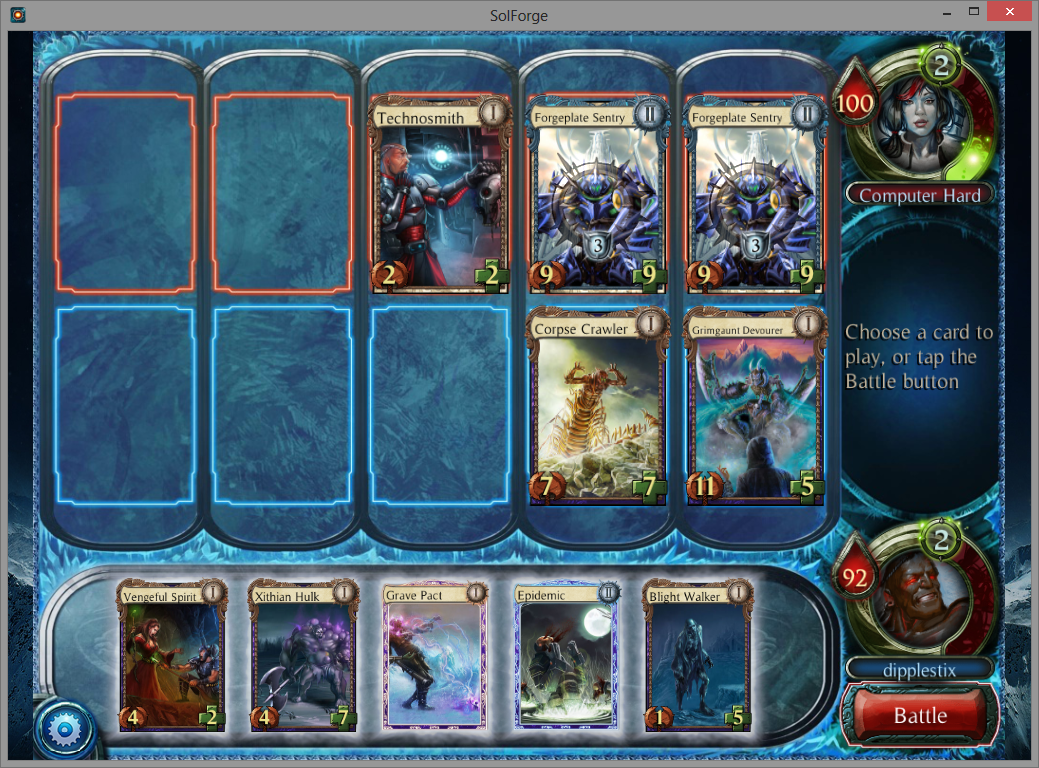
The goal this turn is to keep our Devourer alive at all costs. Two plays accomplish this:
1) Play Vengeful Spirit in lane 3, Grave pact their Forge Sentry, then attack. This leaves us with a 13/4 Devourer and then with a 9/5 Forgeplate Sentry in lane 4.
2) Grave Pact sacrificing Crawler, then Epidemic. This leaves us with an 9/3 Devourer and them with a 4/4 Forgeplate Sentry.
Option 2 is much better as every card in their deck (besides a level 1 Warden) can deal 4 or more, and the second option slows down their clock considerably.

Devourer in lane 2, Death Seeker in lane 4. Not remotely close to do otherwise.

Once again, as our priority is to keep Devourer alive, we have two options once again:
1) Level 1 Cralwer sacrificing Warroir into lane 3, level 2 Crawler sacrificing crawlwe into lane 1. This leaves us with a 15/4 Devourer and a 13/6 crawler and them with a 6/5 Sentry.
2) Grave Pact Sacrificng Warrior and Glutton into lane 1. This leaves us with a 13/8 Devourer and them with a 6/4 Sentry and 8/2 Technomancer.
Option 1 makes Devourer more vulnerable, but they have to deal with it on their next turn and we have a much better board position so I chose to go with that. Option 2 gives a much higher chance of Devourer surviving, but costs us too much board position to do so.

Attack, play Death Seeker anywhere, then Epidemic.

Things are starting to look grim. Attack, place Spiriting into lane 2 and Glutton into lane 5 and pass.

At this point our only chance is to draw an Epidemic and win from there so this becomes a game where we have to prioritize damage mitigation. Playing Devourer into lane 2 to trade with Warden and Seeker into lane 4 means we'll take 30 next turn, the least amound possible for us to take. We fail to draw Epidemic next turn and die. :(
Sunday, May 19, 2013
Pro Player Club Changes after #PTDGM
Josh Utter-Leyton went from Platinum to Platinum
Tom Martell went from Platinum to Platinum
Yuya Watanabe went from Platinum to Platinum
Eric Froehlich went from Silver to Platinum
Ben Stark went from Gold to Platinum
Brian Kibler went from Platinum to Platinum
Shuhei Nakamura went from Platinum to Platinum
Shahar Shenhar went from Platinum to Platinum
Stanislav Cifka went from Platinum to Platinum
Martin Juza went from Platinum to Platinum
Willy Edel went from Gold to Platinum
David Ochoa went from Platinum to Platinum
Reid Duke went from Gold to Platinum
Owen Turtenwald went from Platinum to Platinum
Makihito Mihara went from Gold to Platinum
Luis Scott-Vargas went from Platinum to Platinum
Craig Wescoe went from Platinum to Platinum
Shi Tian Lee went from Nothing to Gold
Tzu-Ching Kuo went from Platinum to Gold
Conley Woods went from Platinum to Gold
Gerry Thompson went from Gold to Gold
samuele Estratti went from Platinum to Gold
Matthew Costa went from Platinum to Gold
Joel Larsson went from Gold to Gold
Jon Stern went from Nothing to Gold
David Sharfman went from Nothing to Gold
Melissa DeTora went from Silver to Gold
Raphael Levy went from Platinum to Gold
Gabriel Nassif went from Nothing to Gold
Ari Lax went from Nothing to Gold
Andrejs Prost went from Gold to Gold
Ivan Floch went from Gold to Gold
Samuel Black went from Platinum to Gold
Patrick Cox went from Gold to Gold
Paul Rietzl went from Platinum to Gold
Christian Calcano went from Silver to Gold
Kelvin Chew went from Silver to Gold
Ken Yukuhiro went from Platinum to Gold
Shota Yasooka went from Platinum to Gold
Stephen Mann went from Nothing to Gold
Jacob Wilson went from Nothing to Gold
Lukas Jaklovsky went from Platinum to Gold
Alexander Hayne went from Platinum to Gold
Denniz Rachid went from Platinum to Gold
Dan Jordan went from Gold to Gold
Dave Shiels went from Silver to Gold
Chris Fennell went from Nothing to Gold
Gaudenis Vidugiris went from Gold to Gold
Jon Finkel went from Platinum to Silver
Thomas Holzinger went from Platinum to Silver
Paulo Vitor Damo da Rosa went from Platinum to Silver
Tomek Pedrakowski went from Gold to Silver
Harry Corvese went from Nothing to Silver
Alex Majlaton went from Silver to Silver
Dusty Ochoa went from Nothing to Silver
Samuel Pardee went from Nothing to Silver
Jeremy Dezani went from Nothing to Silver
Maksym Gryn went from Nothing to Silver
Satoshi Yamaguchi went from Nothing to Silver
Andreas Nordahl went from Gold to Silver
Felipe Tapia Becerra went from Nothing to Silver
Elias Watsfeldt went from Gold to Silver
Miguel Gatica went from Nothing to Silver
Matthew Nass went from Gold to Silver
Brian Demars went from Nothing to Silver
Eduardo Sajgalik went from Silver to Silver
Sebastian Denno went from Nothing to Silver
Robin Dolar went from Nothing to Silver
Brad Nelson went from Silver to Silver
Hao-Shan Huang went from Gold to Silver
Jonas Koestler went from Silver to Silver
Brock Parker went from Nothing to Silver
louis Deltour went from Nothing to Silver
Matteo Versari went from Nothing to Silver
Bo Li went from Nothing to Silver
Roberto Gonzales went from Nothing to Silver
Ben Friedman went from Gold to Silver
Lucas Siow went from Nothing to Silver
José Francisco Silva went from Nothing to Silver
Justin Cheung went from Nothing to Silver
Gerard Fabiano went from Silver to Silver
Joe Demestrio went from Nothing to Silver
Rob Castellon went from Nothing to Silver
Andrew Shrout went from Nothing to Silver
Andreas Ganz went from Gold to Silver
Robert Jurkovic went from Platinum to Silver
Matej Zatlkaj went from Nothing to Silver
Patrick Chapin went from Gold to Silver
Zvi Mowshowitz went from Nothing to Silver
Frank Skarren went from Nothing to Silver
richmond Tan went from Nothing to Silver
Vidianto Wijaya went from Nothing to Silver
Juan Carlos Adebo Diaz went from Nothing to Silver
Tamas Nagy went from Gold to Silver
Alessandro Portaro went from Gold to Silver
Matthias Hunt went from Gold to Silver
Max Sjoblom went from Gold to Silver
Marc Lalague went from Nothing to Silver
Kenny Oberg went from Gold to Silver
Thomas Enevoldsen went from Nothing to Silver
Michael Majors went from Nothing to Silver
Ali Aintrazi went from Gold to Silver
Nicolas Cuenca went from Nothing to Silver
Timothée Simonot went from Silver to Silver
Lukas Tajak went from Nothing to Silver
daniel Royde went from Gold to Silver
Tomoharu Saito went from Nothing to Silver
Andrew Cantillana went from Nothing to Silver
Sveinung Bjørnerud went from Gold to Silver
Chapman Sim went from Nothing to Silver
Matthew Sperling went from Silver to Silver
Wenzel Krautmann went from Nothing to Silver
Mike Krasnitski went from Nothing to Silver
Richard Bland went from Platinum to Silver
Jesse Hampton went from Platinum to Silver
Tyler Lytle went from Nothing to Silver
Andrew Cuneo went from Gold to Silver
Who fell off completely:
Jeremy Neeman went from Gold to Nothing
Vincent Lemoine went from Gold to Nothing
Lukas Blohon went from Gold to Nothing
Chikara Nakajima went from Gold to Nothing
Allan Christensen went from Gold to Nothing
Alexander West went from Gold to Nothing
Jelger Wiegersma went from Gold to Nothing
Bernd Brendemühl went from Gold to Nothing
Ruben Snijdewind went from Gold to Nothing
Marc Anderson went from Gold to Nothing
Marcello Calvetto went from Gold to Nothing
Ryota Endo went from Gold to Nothing
Junya Iyanaga went from Gold to Nothing
Jackie Lee went from Gold to Nothing
Ryuichiro Ishida went from Gold to Nothing
Mamoru Nagai went from Gold to Nothing
Tom Martell went from Platinum to Platinum
Yuya Watanabe went from Platinum to Platinum
Eric Froehlich went from Silver to Platinum
Ben Stark went from Gold to Platinum
Brian Kibler went from Platinum to Platinum
Shuhei Nakamura went from Platinum to Platinum
Shahar Shenhar went from Platinum to Platinum
Stanislav Cifka went from Platinum to Platinum
Martin Juza went from Platinum to Platinum
Willy Edel went from Gold to Platinum
David Ochoa went from Platinum to Platinum
Reid Duke went from Gold to Platinum
Owen Turtenwald went from Platinum to Platinum
Makihito Mihara went from Gold to Platinum
Luis Scott-Vargas went from Platinum to Platinum
Craig Wescoe went from Platinum to Platinum
Shi Tian Lee went from Nothing to Gold
Tzu-Ching Kuo went from Platinum to Gold
Conley Woods went from Platinum to Gold
Gerry Thompson went from Gold to Gold
samuele Estratti went from Platinum to Gold
Matthew Costa went from Platinum to Gold
Joel Larsson went from Gold to Gold
Jon Stern went from Nothing to Gold
David Sharfman went from Nothing to Gold
Melissa DeTora went from Silver to Gold
Raphael Levy went from Platinum to Gold
Gabriel Nassif went from Nothing to Gold
Ari Lax went from Nothing to Gold
Andrejs Prost went from Gold to Gold
Ivan Floch went from Gold to Gold
Samuel Black went from Platinum to Gold
Patrick Cox went from Gold to Gold
Paul Rietzl went from Platinum to Gold
Christian Calcano went from Silver to Gold
Kelvin Chew went from Silver to Gold
Ken Yukuhiro went from Platinum to Gold
Shota Yasooka went from Platinum to Gold
Stephen Mann went from Nothing to Gold
Jacob Wilson went from Nothing to Gold
Lukas Jaklovsky went from Platinum to Gold
Alexander Hayne went from Platinum to Gold
Denniz Rachid went from Platinum to Gold
Dan Jordan went from Gold to Gold
Dave Shiels went from Silver to Gold
Chris Fennell went from Nothing to Gold
Gaudenis Vidugiris went from Gold to Gold
Jon Finkel went from Platinum to Silver
Thomas Holzinger went from Platinum to Silver
Paulo Vitor Damo da Rosa went from Platinum to Silver
Tomek Pedrakowski went from Gold to Silver
Harry Corvese went from Nothing to Silver
Alex Majlaton went from Silver to Silver
Dusty Ochoa went from Nothing to Silver
Samuel Pardee went from Nothing to Silver
Jeremy Dezani went from Nothing to Silver
Maksym Gryn went from Nothing to Silver
Satoshi Yamaguchi went from Nothing to Silver
Andreas Nordahl went from Gold to Silver
Felipe Tapia Becerra went from Nothing to Silver
Elias Watsfeldt went from Gold to Silver
Miguel Gatica went from Nothing to Silver
Matthew Nass went from Gold to Silver
Brian Demars went from Nothing to Silver
Eduardo Sajgalik went from Silver to Silver
Sebastian Denno went from Nothing to Silver
Robin Dolar went from Nothing to Silver
Brad Nelson went from Silver to Silver
Hao-Shan Huang went from Gold to Silver
Jonas Koestler went from Silver to Silver
Brock Parker went from Nothing to Silver
louis Deltour went from Nothing to Silver
Matteo Versari went from Nothing to Silver
Bo Li went from Nothing to Silver
Roberto Gonzales went from Nothing to Silver
Ben Friedman went from Gold to Silver
Lucas Siow went from Nothing to Silver
José Francisco Silva went from Nothing to Silver
Justin Cheung went from Nothing to Silver
Gerard Fabiano went from Silver to Silver
Joe Demestrio went from Nothing to Silver
Rob Castellon went from Nothing to Silver
Andrew Shrout went from Nothing to Silver
Andreas Ganz went from Gold to Silver
Robert Jurkovic went from Platinum to Silver
Matej Zatlkaj went from Nothing to Silver
Patrick Chapin went from Gold to Silver
Zvi Mowshowitz went from Nothing to Silver
Frank Skarren went from Nothing to Silver
richmond Tan went from Nothing to Silver
Vidianto Wijaya went from Nothing to Silver
Juan Carlos Adebo Diaz went from Nothing to Silver
Tamas Nagy went from Gold to Silver
Alessandro Portaro went from Gold to Silver
Matthias Hunt went from Gold to Silver
Max Sjoblom went from Gold to Silver
Marc Lalague went from Nothing to Silver
Kenny Oberg went from Gold to Silver
Thomas Enevoldsen went from Nothing to Silver
Michael Majors went from Nothing to Silver
Ali Aintrazi went from Gold to Silver
Nicolas Cuenca went from Nothing to Silver
Timothée Simonot went from Silver to Silver
Lukas Tajak went from Nothing to Silver
daniel Royde went from Gold to Silver
Tomoharu Saito went from Nothing to Silver
Andrew Cantillana went from Nothing to Silver
Sveinung Bjørnerud went from Gold to Silver
Chapman Sim went from Nothing to Silver
Matthew Sperling went from Silver to Silver
Wenzel Krautmann went from Nothing to Silver
Mike Krasnitski went from Nothing to Silver
Richard Bland went from Platinum to Silver
Jesse Hampton went from Platinum to Silver
Tyler Lytle went from Nothing to Silver
Andrew Cuneo went from Gold to Silver
Who fell off completely:
Jeremy Neeman went from Gold to Nothing
Vincent Lemoine went from Gold to Nothing
Lukas Blohon went from Gold to Nothing
Chikara Nakajima went from Gold to Nothing
Allan Christensen went from Gold to Nothing
Alexander West went from Gold to Nothing
Jelger Wiegersma went from Gold to Nothing
Bernd Brendemühl went from Gold to Nothing
Ruben Snijdewind went from Gold to Nothing
Marc Anderson went from Gold to Nothing
Marcello Calvetto went from Gold to Nothing
Ryota Endo went from Gold to Nothing
Junya Iyanaga went from Gold to Nothing
Jackie Lee went from Gold to Nothing
Ryuichiro Ishida went from Gold to Nothing
Mamoru Nagai went from Gold to Nothing
Saturday, May 18, 2013
Pro Level Changes
NOTE: These are not including the points from PTDM, so this list will be updated soon.
| |||||||||||||||||||||||||||||||||||||||||||||||||||||||||||||||||||||||||||||||||||||||||||
Who fell off?: Richard Bland went from Platinum to Nothing Jesse Hampton went from Platinum to Nothing Robert Jurkovic went from Platinum to Nothing Jeremy Neeman went from Gold to Nothing Vincent Lemoine went from Gold to Nothing Lukas Blohon went from Gold to Nothing Chikara Nakajima went from Gold to Nothing Allan Christensen went from Gold to Nothing Ali Aintrazi went from Gold to Nothing Kenny Oberg went from Gold to Nothing Patrick Chapin went from Gold to Nothing Alessandro Portaro went from Gold to Nothing Alexander West went from Gold to Nothing Jelger Wiegersma went from Gold to Nothing Sveinung Bjørnerud went from Gold to Nothing Bernd Brendemühl went from Gold to Nothing Ruben Snijdewind went from Gold to Nothing Marc Anderson went from Gold to Nothing Matthias Hunt went from Gold to Nothing Marcello Calvetto went from Gold to Nothing Andrew Cuneo went from Gold to Nothing Ryota Endo went from Gold to Nothing Junya Iyanaga went from Gold to Nothing daniel Royde went from Gold to Nothing Jackie Lee went from Gold to Nothing Ryuichiro Ishida went from Gold to Nothing Mamoru Nagai went from Gold to Nothing Max Sjoblom went from Gold to Nothing |
Thursday, May 16, 2013
PT Team Preview
Going purely based off Lauren's team rosters which you can find here
Team Australia
The team has fomrer PT start Jeremy Neeman (he took time off form the game for his studies iirc) and small child prodigy Zen Takashi who has three PT qualifications before he turned 16. I don't know how much they tested, but the overall tea composition is mostly people not used to the testing process for a PT and, combined with the jetlag from travelling, I sadly don't see a great level of success coming from this team.
Predicted members in the T16: 0-1
Team Channel Fireball
One of the "big two" teams of Magic, the CFB roster for this PT has expanded dramatically with the addition of GerryT, Matt Nass, and Shahar. CFB consistently performs well in the limited portion of the event (I assume this is due to the contributions of BenS and EFro), but has struggled in some recent constructed formats. This struggle is further amplified by the two star players having a huge slump this year. Hopefully PTDM allows PV and LSV to hit platinum, but I think it requires about a T8 for either of them to do so. But I expect the team to do quite well at the PT (anyone not picking EFro in your fantasy PT drafts is committing a serious error).
Predicted number in the T16: 4
European Union
The third strongest team in the tournament, headlined by the second best player of all time. In addition to the juggernaut, the team also includes the extremely underrated Jurkovich and Floch. I expect this team to compete with team SCG for the best constructed performance overall, but the limited portion of the event has been the downfall of previous iterations of this team. Time will tell if they're better prepared for PTDM.
Predicted number in the T16: 3
Team Luxurious Hair
The team most likely to find some off-the-wall aggro deck thanks to the combined powers of Wescoe and Ari Lax. If the deck they find isn't good, they won't perform well, but otherwise should put up some above average numbers.
Predicted number in the T16: 0-1
Team Rourix
The Brazilian team is much better than anyone will give them credit for. The combination of Edel and Kaoz_zeh is pretty lethal in a format where midrange green decks are good, so I expect them to surpass everyone's (even my own) expectations for them.
Predicted number in the T16: 1 (it's a small team)
Team Starcity
The other "big two" team and a 17-member power squad. Sam Black and Zvi are known for creating decks to beat the PT meta and have had an incredible level of success doing so in the past so nothing different should be expected here especially when combined with Chapin's theorycrafting power now (I think he was part of CFB for the last PT).
Predicted number in the T16: 4
Wilson Gone Wild
The team that's the biggest wildcard in the event. If they put actual work into testing, they'd perform solidly, but I don't think they'll do so. This is the team most likely to get wasted the night before the event, make a brew, write "YOLO!" on their deck boxes and jam it the next day. Possible I'm very wrong on this one, but meh.
Predicted number in the T16: 1
None of the other teams listed really got my interest/hopes of a strong performance up. This is just unfiltered thoughts so don't judge me and I could be wildly wrong here. :P
Team Australia
The team has fomrer PT start Jeremy Neeman (he took time off form the game for his studies iirc) and small child prodigy Zen Takashi who has three PT qualifications before he turned 16. I don't know how much they tested, but the overall tea composition is mostly people not used to the testing process for a PT and, combined with the jetlag from travelling, I sadly don't see a great level of success coming from this team.
Predicted members in the T16: 0-1
Team Channel Fireball
One of the "big two" teams of Magic, the CFB roster for this PT has expanded dramatically with the addition of GerryT, Matt Nass, and Shahar. CFB consistently performs well in the limited portion of the event (I assume this is due to the contributions of BenS and EFro), but has struggled in some recent constructed formats. This struggle is further amplified by the two star players having a huge slump this year. Hopefully PTDM allows PV and LSV to hit platinum, but I think it requires about a T8 for either of them to do so. But I expect the team to do quite well at the PT (anyone not picking EFro in your fantasy PT drafts is committing a serious error).
Predicted number in the T16: 4
European Union
The third strongest team in the tournament, headlined by the second best player of all time. In addition to the juggernaut, the team also includes the extremely underrated Jurkovich and Floch. I expect this team to compete with team SCG for the best constructed performance overall, but the limited portion of the event has been the downfall of previous iterations of this team. Time will tell if they're better prepared for PTDM.
Predicted number in the T16: 3
Team Luxurious Hair
The team most likely to find some off-the-wall aggro deck thanks to the combined powers of Wescoe and Ari Lax. If the deck they find isn't good, they won't perform well, but otherwise should put up some above average numbers.
Predicted number in the T16: 0-1
Team Rourix
The Brazilian team is much better than anyone will give them credit for. The combination of Edel and Kaoz_zeh is pretty lethal in a format where midrange green decks are good, so I expect them to surpass everyone's (even my own) expectations for them.
Predicted number in the T16: 1 (it's a small team)
Team Starcity
The other "big two" team and a 17-member power squad. Sam Black and Zvi are known for creating decks to beat the PT meta and have had an incredible level of success doing so in the past so nothing different should be expected here especially when combined with Chapin's theorycrafting power now (I think he was part of CFB for the last PT).
Predicted number in the T16: 4
Wilson Gone Wild
The team that's the biggest wildcard in the event. If they put actual work into testing, they'd perform solidly, but I don't think they'll do so. This is the team most likely to get wasted the night before the event, make a brew, write "YOLO!" on their deck boxes and jam it the next day. Possible I'm very wrong on this one, but meh.
Predicted number in the T16: 1
None of the other teams listed really got my interest/hopes of a strong performance up. This is just unfiltered thoughts so don't judge me and I could be wildly wrong here. :P
Thursday, January 24, 2013
Let's Make a Team of PTQ Grinders!
A few years ago I had the opportunity to be a member of Gavin Verhey's Team Unknown Stars, which is probably the first "turning point" of how I thought of Magic. At the time my results were awful (a lot of PTQ T8s, but never won a quarterfinals match), but I was lucky to be accepted thanks to having a lot of friends already on the team who thought I had potential. While on the team, I still never won a PTQ (that wouldn't be until turning point #2 upon getting back from New Zealand), but my results improved, I played a large part in the design of the UB Mannequin deck, and I got to network with tons of amazing players who ended up "breaking through". So, since I've been out of Magic for around a year now I'm going to try forming something similar to the old Team Unknown Stars. Looking for 10-15 people to start and will start as a mailing list/Skype group, but maybe a forum will be in the near future. The goal is to foster a discussion of the current PTQ format and get members on to the Pro Tour. TO foster this goal, I'm going to be rather strict about who gets to be a part of this and am requiring an application. If you're interested in joining fill out the following application (mostly stolen from the old TUS forum) and e-mail me at chrism315 at gmail dot com with the subject "Team Application":
-Your Name and age
-Your Magic accomplishments
-The last three major tournaments you attended and your record at each of them (Major tournaments are considered to be large events such as PTQ's, Regionals, Champs, Nationals, the Pro Tour, and other events on those levels or higher.)
-Why you play competitive Magic
-What your main reasons are for wanting to join the team
-What you think you would bring to the team that makes you stand out above other applicants
-What your strengths as a Magic player are
-What your weakness as a Magic player are
-What the main formats that you play and focus on are
-Which format you think you're most proficient in
-How much modo do you play? What's your screenname?
-Do you have a blog or write for a site? If so, link to your work.
Thursday, January 17, 2013
Worst of 2012
On the other hand there are tons of
articles produced this year that probably shouldn’t exist. Wes Wise’s Magic 8-Ball article (http://www.starcitygames.com/magic/finance/23516_Wise_Buys_Are_You_Smarter_Than_A_Magic_8Ball.html)
is one of the most out-of-place pieces of financial writing ever and I don’t
really know what to say about it. Read
it at your own risk. Ben Bleiweiss’ DKA
set review (http://www.starcitygames.com/magic/finance/23507_The_Financial_Value_Of_Dark_Ascension.html)
was super misleading given his past results and I even wrote a blog post about
it (http://yourarticleisbad.blogspot.com/2012/01/financial-value-of-dark-ascension.html).
My article, Chasing Kate (http://www.gatheringmagic.com/chrismascioli-chasing-kate-why-and-how-i-qualified-for-pro-tour-dark-ascension/),
unfortunately also ends up here. Jesse
Mason and Jon Corpora warned me not to publish this and boy, should I have
listened. I don’t really know what to
say about this one and it probably would have ended up as my worst article of
2012 had it not been for one very special gem by Jon Agley (http://www.starcitygames.com/magic/standard/23602_Grinding_A_Question_Of_Values.html),
described by none other than Pat Chapin as:
Monday, December 17, 2012
Sandy Hook and the Stigma of the "Other"
In the aftermath of the Sandy Hook shooting a lot of media focus has been on mental care in the US, and not in a good way. The focus has been making punitive measures against those who would dare to have something be "not right" with them and ensuring that they lose even more of their rights. The same thing happens almost every major act of violence, the first step is to assign a sense of "otherness" to the assailant: he was a gang member, he was Islamic, he was mentally unwell, etc. Once this blame on some "issue" has been placed the media sets its fucking sights on this minority culture and finds every way possible to blame every world ill on it: how welfare creates a criminal class, how we "apologize" to Islamic nations, how psychological treatment is not reals, any attack on what our culture sees as an "entitlement". Of course this is bullshit and just a refusal to see that the real entitlements go to selfish SAWCSMs (Straight, Ablebodied, White, CiSgendered, Male): Rather than acknowledge that everyone is ENTITLED to a decent life, we make sure to vilify the poor as lazy; rather than let everyone be ENTITLED to their own religious beliefs we find the most extreme elements of other belief systems and attribute it to the whole group; rather than let everyone be ENTITLED to some basic feeling of happiness, society tells us we have nothing to be upset over and to just "go out into the world". While mental health does suck in the US, this is all simply a derail to avoid confronting a culture that feels entitled to guns and a culture that affirms a definition of "manliness" defined by power and violence towards others and this needs to change. Of course any attempt to change the culture is seen as (lol) misandry (just look as seminars telling people to not rape is "labeling all men as rapists") and there's no way to change this unless we are relentless in sending messages out to change.
As a personal note for the last 10 years I was conditioned to seeing my depression as a problem, I had to deprecate myself to fit in while being left to fight my personal demons and daily thoughts of self-harm/suicide alone. Last week I finally sought treatment as a last resort and I have literally never felt more free than I do now. So a huge FUCK YOU to everyone who marginalized and belittled me and I don't want anyone else to go through what I have and labeling anyone with a mental health issue as a future killer sure as fuck won't help.
Thursday, December 13, 2012
Do You Feel Like a Hero?
Do You Feel Like a Hero? - My (Belated) Spec Ops: The Line "Review"
[SPOILER WARNING!!!]
1) I don't really find running around the Middle East and killing terrorists particularly engaging or fun.
2) I play video games partially for an escape and a lot of gunshots, blood, and death doesn't exactly do that.
3) I value my video game time as a solitary experience and generally dislike multiplayer which is the main reason the genre exists.
So when Spec Ops: The Line was released earlier this year I didn't even give it a second look due to its genre. Luckily for me someone whose opinion I respect when it comes to writing/storytelling (Jesse Mason, @killgoldfish) convinced me to play the game.
Gameplay
"Yes, there is darkness to come. But take heart, the storm will soon break"
-Konrad's final orders to the 33rd
We'll just get the actual gameplay out of the way first: it's passable, but nothing exciting. The only new mechanic they introduce is the use of breaking windows to "drown" your enemies in sand, but the execution is super confusing and you only have to make use of it around three times throughout the entire course of the game (these sand sections were the source of the majority of my deaths, :(). Otherwise, it's just a very ordinary third person shooter (with a slightly buggy cover system that sometimes doesn't do what you expect). The game is not worth playing for the gameplay alone and if it didn't come so highly recommended I would have quit at around the two hour mark since the game takes time to pick up and the first 50% or so of playtime is your generic MMS (this is on purpose though, as will be addressed later).
Story
"And yet, they still take time to smell the dying roses"
-Radioman, intel on the citizens of Dubai
The game's story is also pretty mediocre. It's obviously supposed to be a "contemporary" (but alternate timeline) take on Conrad's Heart of Darkness, but has nowhere near the power of the original text or the other famous contemporary take on the story, Apocalypse Now. The story, at times, seems like it has a lot of potential, but then the heavy-handedness of the developers shows up and dashes any hope of that. The developers want you to know that war has consequences and people die. They want you to know it so much that they make you walk (they don't let you use the run command in these portions of the game) through corridors of dead bodies at least four times (I honestly lost count) as well as a few hallucinations where you see enemies looking like your team members (but kill them anyways). On top of the heavy-handedness of the overall message, the ending is basically as cliche as you can get with the major revelation that the antagonist was dead the whole time and you've been carrying around the phone Rick uses to talk to Lori while a number of the events you've gone through in the game have been an illusion (which makes no sense given how your team members reacted to the events, especially when you had to pick which prisoner to execute, unless that was all also an illusion) which is the most intellectually unsatisfying ending imaginable. The story is still a drastic improvement compared to the usual privileged white American male fantasy of killing thousands of Brown people so it's not a complete flop, just not as good as it should be.
There are still a number of things the story does well though. The voice acting is top notch and the characters are well developed as things spiral more and more out of control. While walking through bodies multiple times dampens the emotional impact, there is one point where the player is given control of essentially a drone to bomb your enemies with white phosphorous (you have to kill every dot on the map or else you fail the mission) to then have to walk through a street of burning corpses only to discover that over half of the casualties you caused are civilians. Another powerful scene is the point outside the radioman's base where the radioman tells you a small bit of backstory about every soldier killed (relevant xkcd).
Why the Game is Incredible
"Where's all this violence comin' from man? Is it the video games? I bet it's the video games"
-Radioman
While the gameplay and story of Spec Ops are nothing special, the game is simply groundbreaking in how it interacts with the player. Contemporary video games, much like premodern paintings, act as a "window" into the world of the game with the intent of placing you in the "shoes" of one of the characters. Impressionism, just like Spec Ops was a completely uninspiring movement in terms of the quality of the final products (people who have Monet's Water Lillies as their favorite painting have no taste), but it was the first movement to embrace the medium: they shattered the view of a painting as a window and instead embraced the canvas as a flat space. Rather than use optical tricks to present the painting as a representation of something physical, the movement chose to purposely "flatten" the image onto the canvas. The depth previously created by using perspective techniques was instead replaced by taking advantage of the physicality of the medium itself: if something was supposed to be thick, you just used more paint. Spec Ops then is the first game to take advantage of being a game (plenty of other games, just like many premodern paintings, broke the 4th wall and acknowledged the medium).
Spec Ops take on the morality/choice system is the most obvious example of this: in the beginning of the game your choices simply do not matter and the game goes out of its way to show this to you. The most jarring example is when you are presented with the choice to save someone who has important intel or to save two civilians (after watching a third be executed). No matter which path you choose (the game took me an extra few hours because I chose to replay each choice multiple times to confirm my suspicions) everyone ends up dead and you end up with no intel. While having choices that don't really matter is nothing new (not hiding the fact might be novel, but that's not a huge deal), it's what the game does starting at around the three hour mark that is: it presents choices where there is only one allowable decision. This is not the same thing as having no choice though, it's very obvious to the player that at any point the team could have just walked away from everything, but that choice was never yours to make since the choices are made by the characters in the game. This removal of choice therefore serves a very important purpose in that it removes you from the position of a character and instead puts you in the position of observer making the game function as interactive fiction in the truest sense and, with this realization, all the game mechanics that originally seemed odd or quaint suddenly fit perfectly. The third person perspective wasn't implemented just for the cover-based combat, but was to show that you're just along for the ride and function as an "invisible" party member. The lack of an in-game soundtrack which is instead replaced by a radio station blasting across Dubai is suddenly the only way to implement music in the game while keeping the 4th wall intact. Even the beginning credits, which cast you as a "special guest" along with your Steam username, play a role in establishing your role in this game as the aforementioned observer.
Spec Ops knows this reveal is a big deal and sets it up beautifully. For the first few hours of the game the player can see themselves as the protagonist as he's the "hero" traditionally associated with the MMS genre. It is only after the killing of a large number of civilians that the player realizes that he is not anywhere close to a hero and they're going to be dragged along for the ride. The irony of Walker continually claiming to have had "no choice" but to do what he has done coincides with the player having less and less choices and the realization that Walker has had every chance, every opportunity to just leave and go home that frustrates the player as they wish more and more they could make it for him. Instead, the player must endure hours more of senseless killing as they step further and further out into Macbeth (literal) river of blood. In one mission your sole objective is just to "obey", if there was ever any doubt of how much the game cared about what you wanted.
The player is given one choice that affects how the game plays out, but I think it was inserted as a test to whether the player correctly understood their role in the game. In the final scene the player is given the choice to observe as Walker kills himself as a consequence of all his decisions or to take responsibility for Walker's choices and shatter the mirror (also significant as without the person in the mirror to blame, the only person Walker can place the burden on is you).
Conclusion
"No matter what, endure. Be ever vigilant. Hold the line"
In the end, Spec Ops is not just an MMS, but instead an examination of the player/character relationships in traditional game design. The antagonist being named Konrad (phonetically identical to Conrad, the author of Heart of Darkness) again lends itself to the idea that you are an observer (or reader, in this case) and not an active participant being told a story by others. The title of this post comes from a question asked to you during a loading screen and the game makes sure that you answer it with a resounding "No".
Friday, June 8, 2012
Chris Tries to Play Poker, Post 1
https://pkrsess.com/h/zd
Random $7 6max hyperturbo. The guy to my left when 6-handed was xartist, who is on the leaderboard for the stakes and the rest are randoms
Hand 3 I should have just raised over shove, but to how much? Thinking 80-100, but no idea.
Hand 19: How would you play it there post flop?
Hand 24: His call was disgustingly bad, :(
Hand 28: If your BB, what's your calling range here? Can you ever call with anything less than KK, AA even if you know villian is shoving ATC. Both other stacks are corpses.
Hand 31: Was this a bad call?
Hand 34 was a misclick, meant to shove, but wrong hotkey.
Hand 35: Should I have just called instead of keeping SB out of the hand? Should I have been in this at all?
Friday, April 27, 2012
My Life is Realistic
I succeeded in completing Project Manchester and arrived in Aberdeen on April 9th and stayed there until April 12th. While I was there I got to meet some great people and decided to head to Stilring after in order to see Stirling Castle and the William Wallace Monument. When I arrived at Stirling I was unable to find the hostel I was supposed to stay at so I ended up in the first one I could find, The Willy Wallace Hostel and was planning to stay in Stirling, spending a day each in Glasgow and Edinburgh (for some reason this city is pronounced Eh-din-brah), until I left for Manchester for the GP. On the Friday before the GP I had a choice of working on something that meant a lot to me or going to the GP and I chose the former. Things ended up going pretty well and I really enjoyed it here (as well as having no real reason to return home right away) so I took a reception position at the hostel and decided to stay here for another month or so and I'm really glad I did (and you should all come visit me obv).
You can find an album with a bunch of the cool stuff I've done on facebook and I'll update it again when I'm not lazy one day.


Since I'm not in the states I also decided to start playing online poker and wanted to give SNGs a try so I read Moshman's book and took some notes (feel free to correct me/add) and after browsing the 2p2 boards it was recommended I give hyperturbos a try. So for around 3ish hours yesterday I 2-tabled hypers, got around 50 games in and ended up down 6 buyins (started at the $1.50s). I think I don't even come close to having the hang of it yet so I'm going to post some stats images so you can try to help tell me what I'm doing wrong:


So, that's my life update for now, you can always reach me on facebook and I turned my tumblr into an AMA if you're bored
Thursday, April 5, 2012
Surviving the Judge Call: A Corollary to My Article
OK, just a quick not that I should have added to the article itself:
When you call a judge for a strategic call, DO NOT LIE. As long as you're honest and admit when you noticed the trigger originally and why you didn't call a judge then you're fine. However, if you lie and say you just noticed or something equally untrue you will be DQed for lying to a judge which is a DQ even if the fundamental action that started the investigation is legal.
When you call a judge for a strategic call, DO NOT LIE. As long as you're honest and admit when you noticed the trigger originally and why you didn't call a judge then you're fine. However, if you lie and say you just noticed or something equally untrue you will be DQed for lying to a judge which is a DQ even if the fundamental action that started the investigation is legal.
Tuesday, March 20, 2012
Project Die Roll
Wizards has recently decided to extend the implementation of the Pro Tour play/draw rule (for those of you who don't know what this is, in the T8 the higher seeded player gets to decide to play or draw without a die roll) to GPs and PTQs. This naturally brings up the question (or should): "How important is winning the die roll?" (more formally: What is P(winning the match|winning the die roll)). In order to find the answer to this question (unless @mtgonline or @lee_sharpe decides to perform a divine intervention and just tell us) I'm going to start a little research project. I'm asking for volunteers to fill out the following Excel Sheet for various daily events:

Put the following expression in column B to save time: =IF(A7=1,2,IF(A7=0,2," "))
The most efficient way to fill out the sheet:
1) Wait for the round of the DE to be over.
 2) Record the records of the round, as you can see above I just recorded each match as it appears in the DE results.
3) Open a match to watch the replay. If the player on the top of the screen wins the roll, assign a B in the third column. If the player on the bottom of the screen wins the role assign an A. Repeat for each match

4) Repeat for the other three rounds.
So I'm looking for volunteers to help collect this data, if you're interested (and can commit to doing one whole DE) e-mail me at chrism315 at gmail dot com.
Chris Mascioli
@dieplstks on twitter

Put the following expression in column B to save time: =IF(A7=1,2,IF(A7=0,2," "))
The most efficient way to fill out the sheet:
1) Wait for the round of the DE to be over.

3) Open a match to watch the replay. If the player on the top of the screen wins the roll, assign a B in the third column. If the player on the bottom of the screen wins the role assign an A. Repeat for each match

4) Repeat for the other three rounds.
So I'm looking for volunteers to help collect this data, if you're interested (and can commit to doing one whole DE) e-mail me at chrism315 at gmail dot com.
Chris Mascioli
@dieplstks on twitter
Thursday, March 15, 2012
MODO Tracking Tool
I was bored and created a spreadsheet to track results and profits (or losses) on modo. You can download it here. You can also look at my oldish article on the EV of various events on Starcity.
Use
The document is pretty simple to use, all it requires is that you input each event you play in, the date of the event, and your record in that event. The following screen capture shows the information required.
 Date: The date of the event (3/14)
Event: The event type (allowable values are 2M (for a constructed 2-man), 8M (for a constructed 8M), DE (for a constructed DE), sDE (for a sealed DE), Swiss (for a swiss draft), 4322 (for a 4-3-2-2 draft), and 84 (for an 8-4 draft). Please note that the limited event tracking does not account for the value of cards opened, but feel free to add that to your profit if you'd like.
Format: The format of the event (for constructed: T2, Block, Momir, Pauper; for limited: M12 and ISD).
Wins: The number of wins you got in the event.
Losses: Number of losses you got in the event.
Since the Spreadsheet takes care of pricing, the only other thing you have to update is in a second included sheet which can be accessed by clicking on the tab on the bottom of Excel.

Once selected the sheet will look like this

All you have to do is put in the date (under Date) and the buying price for ISD, DKA, and M12. If you do not put in the price for a date the tracking functionality will not track profits correctly.
I present this for free (and just give the raw sheets so they can be customized to your liking), but if you feel like you got any particular value out of this (or you just <3 me), feel free to donate (which will inspire me to make more/better/useful tools in the future):
Use
The document is pretty simple to use, all it requires is that you input each event you play in, the date of the event, and your record in that event. The following screen capture shows the information required.

Event: The event type (allowable values are 2M (for a constructed 2-man), 8M (for a constructed 8M), DE (for a constructed DE), sDE (for a sealed DE), Swiss (for a swiss draft), 4322 (for a 4-3-2-2 draft), and 84 (for an 8-4 draft). Please note that the limited event tracking does not account for the value of cards opened, but feel free to add that to your profit if you'd like.
Format: The format of the event (for constructed: T2, Block, Momir, Pauper; for limited: M12 and ISD).
Wins: The number of wins you got in the event.
Losses: Number of losses you got in the event.
Since the Spreadsheet takes care of pricing, the only other thing you have to update is in a second included sheet which can be accessed by clicking on the tab on the bottom of Excel.
Once selected the sheet will look like this

All you have to do is put in the date (under Date) and the buying price for ISD, DKA, and M12. If you do not put in the price for a date the tracking functionality will not track profits correctly.
I present this for free (and just give the raw sheets so they can be customized to your liking), but if you feel like you got any particular value out of this (or you just <3 me), feel free to donate (which will inspire me to make more/better/useful tools in the future):
Subscribe to:
Posts (Atom)