Tuesday, March 20, 2012

Project Die Roll

Wizards has recently decided to extend the implementation of the Pro Tour play/draw rule (for those of you who don't know what this is, in the T8 the higher seeded player gets to decide to play or draw without a die roll) to GPs and PTQs.  This naturally brings up the question (or should):  "How important is winning the die roll?" (more formally:  What is P(winning the match|winning the die roll)).  In order to find the answer to this question (unless @mtgonline or @lee_sharpe decides to perform a divine intervention and just tell us) I'm going to start a little research project.  I'm asking for volunteers to fill out the following Excel Sheet for various daily events:


Put the following expression in column B to save time:  =IF(A7=1,2,IF(A7=0,2," "))

The most efficient way to fill out the sheet:
1)  Wait for the round of the DE to be over.
2)  Record the records of the round, as you can see above I just recorded each match as it appears in the DE results.
3)  Open a match to watch the replay.  If the player on the top of the screen wins the roll, assign a B in the third column.  If the player on the bottom of the screen wins the role assign an A.  Repeat for each match


4)  Repeat for the other three rounds.

So I'm looking for volunteers to help collect this data, if you're interested (and can commit to doing one whole DE) e-mail me at chrism315 at gmail dot com.

Chris Mascioli
@dieplstks on twitter


Thursday, March 15, 2012

MODO Tracking Tool

I was bored and created a spreadsheet to track results and profits (or losses) on modo. You can download it here.  You can also look at my oldish article on the EV of various events on Starcity.

Use


The document is pretty simple to use, all it requires is that you input each event you play in, the date of the event, and your record in that event. The following screen capture shows the information required.
Date:  The date of the event (3/14)
Event:  The event type (allowable values are 2M (for a constructed 2-man), 8M (for a constructed 8M), DE (for a constructed DE), sDE (for a sealed DE), Swiss (for a swiss draft), 4322 (for a 4-3-2-2 draft), and 84 (for an 8-4 draft).  Please note that the limited event tracking does not account for the value of cards opened, but feel free to add that to your profit if you'd like.
Format:  The format of the event (for constructed:  T2, Block, Momir, Pauper; for limited:  M12 and ISD).
Wins:  The number of wins you got in the event.
Losses:  Number of losses you got in the event.

Since the Spreadsheet takes care of pricing, the only other thing you have to update is in a second included sheet which can be accessed by clicking on the tab on the bottom of Excel.


Once selected the sheet will look like this


All you have to do is put in the date (under Date) and the buying price for ISD, DKA, and M12.  If you do not put in the price for a date the tracking functionality will not track profits correctly.


I present this for free (and just give the raw sheets so they can be customized to your liking), but if you feel like you got any particular value out of this (or you just <3 me), feel free to donate (which will inspire me to make more/better/useful tools in the future):


Chris Mascioli
@dieplstks on Twitter

Saturday, March 3, 2012

#MOCSGate

Two known players have decided to have other people play in the MOCS for them today.  While this is usually impossible to detect, these two players decided to play in real life events (an SCGOpen and a GP) that are occurring at the SAME TIME as said MOCS.  It's time to make some call outs:

1)  Stephen G. Mann, smann on modo:


2)  Andrejs Prost, baconator5000 on modo


Chris Mascioli
@dieplstks on Twitter (follow me!  Please)

Thursday, March 1, 2012

#dieplstksCotD

Apparently twitter doesn't save tweets very long, here's the original three posts from my Stupid Fucking Magic Article Comment of the Day:

Scott Seaver


This comment was about Edgar Flores being banned
John Crutcher
This was about the playmat art

Wednesday, February 29, 2012

Your Comments are Fucking Stupid: Women in Magic Edition


I'm not going to provide any commentary, the comments do that for themselves

Grahm Salva


Matthew Viviani

Andrew J. Nagy

Thomas Ray Smith, who is "a hopeless romantic, big teddy bear, with a heart of Gold. I have a good sense of humor, and a playful personality. I have a mature and intelligent mind. My heart is very passionate, and loyal.I am laid, back fun loving kind of guy"


Chris Mascioli
@dieplstks

Friday, February 17, 2012

The Myth of Male Objectification

The fact that I have to write this blog post in 2012 is pretty scary, but the need for a clear definition of what objectification has been made strikingly clear by the comments on Jesse Mason's most recent article on females in Magic art ( http://www.gatheringmagic.com/jessemason-021612-anti-flavor-dissertation/).

Objectification is, by strict definition, the treatment of a person as solely a physical object rather than a sentient and emotional being.  So, when the subject of how females were objectified in Magic art was mentioned a group of scholars had a brilliant, earth-shattering, and novel idea that they all rushed to post (followed by these rogue academics patting themselves on the back):  MALES ARE OBJECTIFIED IN MAGIC ART TOO (so brave!).  While these posters are technically correct (the best kind of correct), they miss the real point of what is being referred to when one makes reference to objectification:  the transformation of a sentient being to a solely physical object to be used.

Let's look at what "male objectification" (it cracked me up a bit just writing that, sorry) looks like:

"Holy shit, he has no shirt!"  
"omg, look at those muscles!"
"That guy is ripped!  I'm jealous"

The fact that this piece of "art" (cracked up again, sorry) brings a deluge of homoerotic thoughts to sheltered neckbeards everywhere is a clear sign that it's an example of male objectification: the transformation of a powerful male into a purely sexual object.  Except it's not actually happening and is just a completely surface/trivial analysis.  If we actually examine the piece we see that Koth is in fact a symbol of power, agency, and confronts/challenges the viewer.  Koth is displayed not as an object for use, but as another type of object -- a monument to be in awe of and admire.  

Let's take a non-Magic look at something people claim is "male objectification" (at least writing this is keeping me amused) - underwear models:

Alright, so once again we have a not fully dressed male.  That means he's a sexual object/pin-up, QED!  Except, like Koth, his sexuality is used to create an image of power, another monument to the male form.  His pose which is seemingly relaxed is not one of acceptance/submission, but instead chosen to highlight his physical power.  His glance is once again a challenge to the viewer, asking not "what would you do to me?" but "what would you let me do to you?"


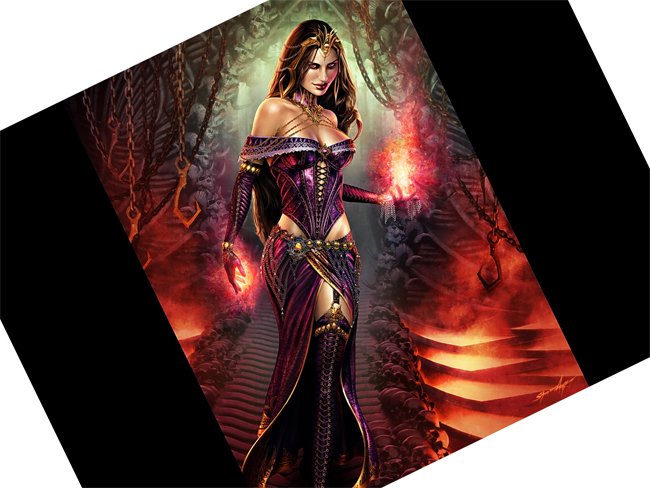
Now, let's compare these images to how a female planeswalker is portrayed, we'll use Argyle's Liliana of the Veil as an example (we're going to use the full art since we can get rid of the ridiculous tilt on the actual card, stealing this from Jesse's article mentioned in the intro):


The depiction of Liliana is very different than that of Koth.  The first thing that needs to be taken into account is the social context in how the images are viewed (for a more in-depth take on this, I suggest everyone reads Laura Mulvey's "Visual Pleasure and Narrative Cinema", I took way too many Art History/Cinema Studies classes in college.  You can find some easy to digest sparknotes of it here).  Western society has historically given and still gives the majority of power to the male portion of its population and continually victimizes and oppresses women (if you don't think this is true, listen to a discussion about rape or birth control)


Therefore the "male gaze" (a term first introduced in the aforementioned Mulvey essay), when given a historical perspective, is one that depends on the political, economic, and sexual oppression of women.  

Liliana's state of undress is also in contrast to Koth's.  While Koth has no shirt to show power (watch any action movie that involves a fighting scene, the male actors involved almost always remove their top to highlight their physical prowess), Liliana's strategic lack of clothing highlights her as a sexual being, emphasizing her shoulders, cleavage, hips, and upper leg.


On top of this Liliana's gaze which is not presented as challenging the viewer (like Koth's), but is instead presented as inviting.  It is no mistake that Liliana is pictured in front of what appears to be a secret lair which you, presumably, want to take her  up to.  Comparing Liliana to some Goth pin-ups confirms the objectification present in Argyle's illustration


Anyone claiming that the objectification of Koth/male models is equivalent to the objectification of Liliana is just choosing to ignore that in the male case Koth is objectified to be a monument while in the female case Liliana is objectified to be another type of figure - a toy.

-Chris Mascioli
@dieplstks on twitter


Wednesday, February 1, 2012

My Pro Tour Testing Group Decided to Test the Fish Mirror

My Pro Tour Dark Ascension playgroup testing 
Working hard

Discussing possible lines of play 
Magic can be tiring


Everyday I'm shufflin' 
Every testing group needs a Tom Ma

The End Boss

Intimidation


Of course, just like every other group we share some good times together afterwards, however one participant imbibed a bit too much, but we got it on film

-Chris Mascioli
@dieplstks on twitter